Coffee Harvest in Panama! How a NC Girl Came to be a Coffee Farmer!
Thanksgiving! Coffee harvest!
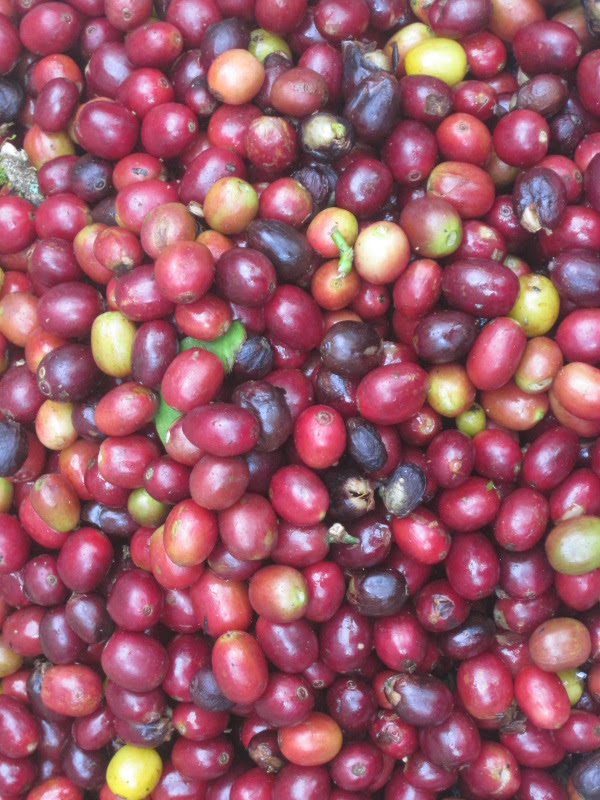
The cherries are red and sweet and there are a lot of them this year. That’s a good thing. Good rains, good sun—everything has aligned for a generous crop of outrageously good coffee. This marks my twenty-second harvest, and still, every season makes me smile and shake my head in wonder.
How did a nice girl from North Carolina end up a coffee farmer in Panama?
I grew up lalternating between the dairy farms of Connecticut and the Blue Ridge Mountains of North Carolina. I always dreamed of living on the side of a volcano and tending coffee trees on the side of a volcano in Central America.
Well. Maybe not exactly.
In truth, I grew up in a household where coffee came from a jar—freeze-dried, instant, stirred into a mug with hot water. I had no idea coffee came from an actual plant. Or that it could taste good.
My conversion came in 1992 during a trip to Seattle. Starbucks was just beginning its empire-building. Suddenly, coffee wasn’t just something you drank to wake up; it was a world. Indonesia, Ethiopia, Sudan, Costa Rica. Viennese, French, Italian roasts. Lattes, cappuccinos, espressos. The smell, the color, the texture…
I became that person: ordering beans overnighted to North Carolina, storing them in special containers, grinding them fresh each morning, perfecting a two-cup French press ritual. I built my own blend—dark, complex, chocolaty, mysterious. I wanted coffee that tasted like an Impressionist painting looked: dreamy, moody, seductive. It was romantic.
I fell hard for The Romance of Coffee.
In 2002, I took what was supposed to be a simple vacation to Panama with my then-husband a a January escape. Sun. Beaches. Boats. Snorkeling. Margaritas. Bocas del Toro was beautiful but hot and steamy. (I like my sex hot and steamy—not my climate.) (Read that whole story here!)
So we hopped a bus over the Cordillera Mountains toward a little highland town called Boquete.
Within forty-eight hours of arriving in that mist-kissed, rainbow-drenched valley, we were already scheming how to stay. Within four days we were standing on the slope of Jaramillo Mountain, staring at a neglected coffee farm for sale. As we walked the property, I plucked my first coffee cherry from a branch. I bit into the sweet, slippery pulp and—just like that—The Romance became a Marriage.
I knew: This is it:
I would move to Boquete and grow organic coffee.
Café Mariposa Azul.
It took two years to finish jobs, graduate children, sell the house, and dismantle our old life. During that long slide toward departure, whenever someone asked how I was, my answer was always the same:
“Fine. But I’d rather be in Panama.”
In 2004 we finally moved and my love affair with coffee—on Finca Luz—grew even hotter.
Finca Luz (“Light Farm”) sits about 5,000 feet in a cloud-forest microclimate on the flank of Jaramillo, a 9,000-plus-foot mountain guarding the eastern side of Boquete Valley. The farm is a riot of tropical abundance: oranges, lemons, limes, guavas, avocados, eucalyptus, lilies, orchids, and more than twelve thousand Arabica coffee trees.
From one direction, you see the Pacific gleaming in the distance. From another, Volcán Barú rises—an almost 12,000-foot sleeping giant. Blue morpho butterflies drift through the deep green coffee. Emerald parrots shriek their way across the valley. Three natural springs spill into clear pools edged with papyrus. Paths wind through sunlit clearings and shadowed forest glens. Wild orchids cling to towering oaks. I love the parrots.
It is breathtaking.
I still haven’t seen the Capuchin monkeys a neighbor swears come through for oranges and bananas. In the night, we hear the peep-peeeeep of the Geoffroy’s tamarin, (also called a mono titi) a tiny 8 inch long monkey that lives high in the trees and looks like a gremlin. In the valley there are coyotes. Once, a panther came and monstered our chickens (but they flew up into a tree, but we could see did see the claw marks in the trunk). There are armadillos. Quick brown squirrels. An ugly type of possum they call a zorro. They are all welcome. There’s room for all of us here. Gratitude for all creatures, great and small.
Twenty-two years later, it is again harvest time. The cherries are ripe, the air hums with birdsong, and I am—every single day—grateful to Panama for welcoming me, for this land sustaining me, and for the joy of drinking coffee grown right here at Finca Luz. Life is good. Thank you.
From flower…to cup. It’s a miracle!